Week 3: Making the Third World: Truman’s Point Four, Third Worldism, and the New International Economic Order

DVST 6901: The global politics of development (Semester 2, 2026)
August 17, 2026

20th century development is a creature of the Cold War and the post-WWII “new world order.” Hence, development as goal and ideal has always been contested. We live in the aftermath of competing alternative concepts of development and competing ideological values and critiques.

Main reading: Getachew (2019), chaps. 3, 5; “Text of the Final Communiqué of Asian-African Conference” (1955); United Nations General Assembly (1974)

Other reading: Rist (2014), chap. 4-6; Illich ([1970] 1973)

Notes

Notes to be added later.

Keywords

Third Worldism and the Non-Aligned Movement, The Allied powers, the United Nations, and the Cold War politics of development

Learning outcomes

A new culture for a new international community

Discuss in small groups what you wrote about for your weekly assignment.

You wrote about a counterfactual, fictional League of Nations that gives a new mandate to powerful societies who rule over powerless societies. Now let’s generalize.

  1. What kind of supervision or oversight should a government have? Who is accountable to whom?

  2. In the absence of “self-government,”

    1. what would you prohibit a government from doing to those that it governs?

    2. what would you require that government to do to or for those it governs?

  3. What would count as success and what would evidence of success be?

And based on your discussion today

  1. What kind of new New World Order would you want to establish by this system? What are the different values, ideals, and aspirations do we as a class have? (Here, focus on what we have in common and what is different and where people in your group disagree.)

Another war, another peace

And “international development.” Truman mentions this in his 1949 inaugural address as a new foreign policy because it sounded good and would make the other three points sound like they were part of a more ambitious vision (Rist 2014, 70).

Everyone started talking about development in a new way. No one has ever known what it meant. It’s not colonialism. It has something to do with the UN and world peace or something. And there’s science and technology.

Is development an aim for our new New World Order?

Liberty versus democracy in the postwar era

Discussion point: What’s so great about human rights?

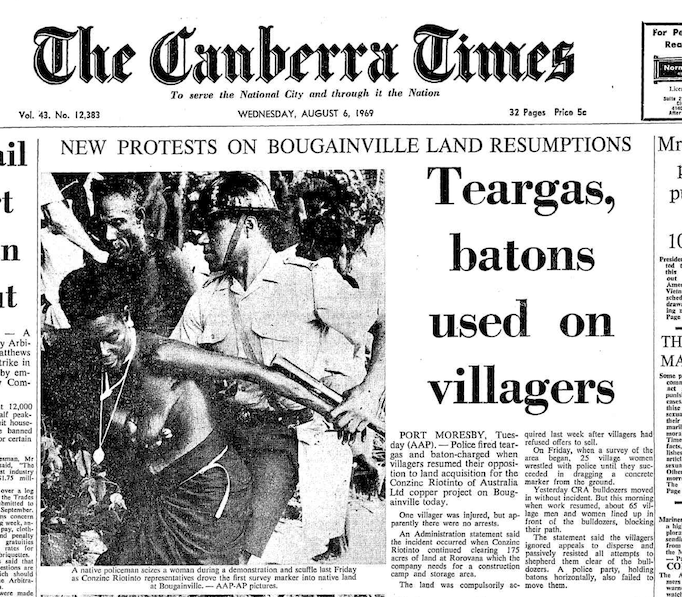
Front page news

A photograph accompanying a news article on the front page of the Canberra Times on August 6, 1969.

For the full article, go to Trove:

Canberra Times (Australian Capital Territory). 1969. “New Protests on Bougainville on Land Resumptions: Teargas, Batons Used on Villagers.” August 6. http://nla.gov.au/nla.news-article136948011.

Bougainville: The beginning

Bougainville: Towards PNG’s independence

Bougainville: The war, the blockade, and then autonomy

Bougainville: What’s next?

Bougainville: Appendix

Sources

Primary

Secondary

AI acknowledgement

This timeline was compiled with the use of a generative AI tool (Claude Opus 5) which summarized and retrieved information from supplied PDF copies of published sources and from web searches. The facts and sources were checked by Ryan and the timeline was edited by Ryan.

A counterfactual response to the Bougainville crisis

Your fictional League sought to manage the end of colonialism. Now imagine that you can create your own international order in which PNG and Bougainville are parts. PNG gains its independence in 1975. When Bougainville has problems—from the 60s to now—your ideal international body is in charge.

  1. Who should be in charge?
  2. What can PNG do and what can’t PNG do?
  3. What is your desired result?

Discuss.


References

Getachew, Adom. 2019. Worldmaking After Empire: The Rise and Fall of Self-Determination. Princeton, N.J.: Princeton University Press.
Illich, Ivan D. (1970) 1973. “Planned Poverty: The End Result of Technical Assistance.” In Celebration of Awareness: A Call for Institutional Revolution, 129–43. Harmondsworth, Eng.: Penguin Education.
Rist, Gilbert. 2014. The History of Development: From Western Origins to Global Faith. Translated by Patrick Camiller. 4th ed. London: Bloomsbury Academic & Professional. http://ebookcentral.proquest.com/lib/usyd/detail.action?docID=5915284.
“Text of the Final Communiqué of Asian-African Conference.” 1955. In Selected Documents of the Bandung Conference: Texts of Selected Speeches and Final Communique of the Asian-African Conference, Bandung, Indonesia, April 18-24, 1955, 29–35. New York: Institute of Pacific Relations. http://archive.org/details/selecteddocument00asia.
United Nations General Assembly. 1974. “Declaration on the Establishment of a New International Economic Order.” Resolutions of the 6th special session, Resolution no. 3201. https://digitallibrary.un.org/record/218450.